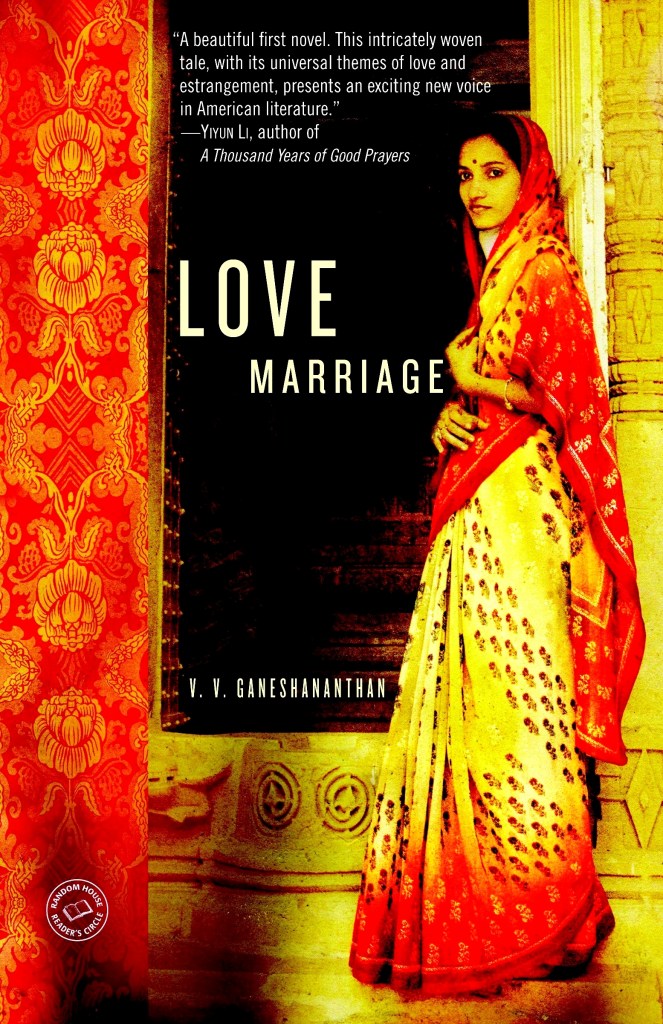
In V.V. Ganeshanthan’s Love Marriage, I saw myself represented for the first time as a second-generation Sri Lankan Tamil woman carrying the weight of the civil war without ever having lived through it. Love Marriage inspired me to pursue my research interests and gave me the words to describe the inner turmoil that many of us, diasporic second-generation Eelam Tamils face–having to pick a side. The novel explores the complexities of nationalism while also highlighting the privileges that those in the diaspora enjoy.
Love Marriage is a fictional archive of one family’s history across three generations. Yalini, born on one of the darkest days in Eelam Tamil history – 24th July 1983 (“Black July”) – attempts to piece together and inscribe her family heritage to make sense of her dual identity. Like me, Yalini grew up aware of the horrific events that transpired across the ocean and was never able to reconcile with the distance between herself and the white American society in which she grew up. Hence, when her uncle (Kumaran) and her cousin (Janani), who are both ex-LTTE (Liberation Tigers of Tamil Eelam) members, immigrate to Canada, Yalini is forced to acknowledge and accept her complicated family history. To make sense of her identity and positionality in relation to the war, Yalini engages in a counter-archival process, where she records stories that are often relegated to the margins. While doing so, she attempts to decipher the complexities of “picking a side” when violence has seeped into the nation and into their lives.
“I told you a story about that place, and about their leaving it, but how do I know it? I am not the end of my parents’ story, but I am the reason for its telling” (Ganeshananthan 15)
An aspect of the story that I found particularly interesting is the forced entrance, or rather the barging in, of her uncle and cousin into Yaalini’s life. In Ghoslty Matters, Avery Gordon argues that “in Haunting, organized forces and systematic structures that appear removed from us make their impact felt in everyday life in a way that confounds our analytic separations and confounds the social separations themselves” (Gordon 19). By Gordon’s definition, Kumaran is a specter intruding into Yalini’s life, forcing her to recognize her unsavoury history. As a child born in the diaspora, Yalini was shielded by her parents from the true realities of the war. When Kumaran mockingly asks her what she knows about the war, Yalini defensively replies that she had read about it in unofficial newsletters (Ganeshananthan 47). Her parents’ trauma and the threat against speaking in support of Tamil Eelam kept Yalini in the dark. Nevertheless, while speaking to Kumaran, she realizes that she “had always known that he was a Tamil Tiger [even though] no one had ever told” her (33). Kumaran represents the “haunting” Gordon defines, the repressed truths that her parents wanted to protect Yalini from. Though physically Kumaran intrudes later into her life, she had felt his presence all along.
The specter appears when it can no longer be contained, when actions and decisions have to be made. For Yalini, it is realizing her privilege as an American-born Tamil Eelam woman, but also recognizing that she cannot live outside of the conflict. Kumaran, Janani, and by extension Tamil Eelam, will continue to “haunt” Yalini to remind of her identity and her responsibility. Yalini, like Ganeshananthan and I, contribute one story to an emerging counter-archive filled with specters known and unknown. Whether it be a fictional story or otherwise, the diasporic Tamil Eelam counter-archive does not shy away from exposing the moral complexities that come with war. It avidly argues that “picking a side”, while living in the diaspora, comes with its own moral obligations when one’s safety and livelihood is no longer compromised. It is this grey zone that we, the second-generation, should strive to navigate more bravely.
 Global Anglophone Tamil Eelam Literature
Leave a comment