“Sometimes Nala imagined that all of their family stories were filed away in that carefully ordered mind of Smrithi’s. She was their family’s memory. That thought comforted her–after she died, Smrithi would remember her for the family. Nala, Rajan, Mohan, Dhara and all the others would not be forgotten. Smriti would remember, and she would tell her children. Perhaps they would tell theirs” (Chandran 429).
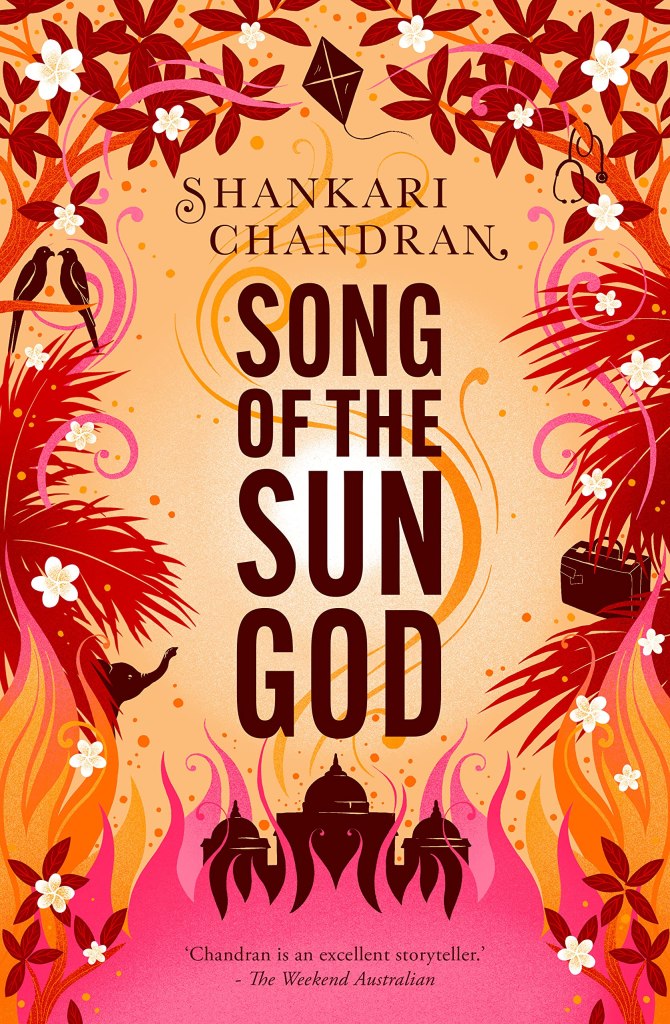
While reading Shankari Chandran’s Song of the Sun God, I was reminded of Marianne Hirsch’s theory on “postmemory”. Postmemory, as Hirsch defines it, “describes the relationship of the second generation to powerful, often traumatic, experiences that preceded their births but that were nevertheless transmitted to them so deeply as to seem to constitute memories in their own right” (Hirsch 1). She elaborates that it is a “structure of inter- and trans-generational transmission of traumatic knowledge and experience” as well as “a consequence of traumatic recall but at a generational remove” (3). Chandran’s novel, which tells the story of an Eelam Tamil family navigating the earlier days of the civil war and eventually migrating to Australia, grapples with the question of what should/not and can/not be passed on to the next generation. The novel contemplates identity formation in the face of an unsafe/missing “home” while pondering: How does one get back home when “home” (as one knows it) no longer exists?
“The English language was clearly limited. There were other words for what happened in July: words in Tamil and words in Sinhalese. But in their common medium of English, the harshness of what one had done to the other was muted: neutered, politely sanitised into socially acceptable conversation pieces” (Chandran 228).
For the one of the protagonist, Smrithi, who migrated to Australia with her aunt’s family as a baby, Eelam is an unrelenting force that continues to pull her towards it. Like her biological mother, her connection to her homeland is like an “umbilical cord that nourishes her just as easily as it could strangle her” (351). Thus, when it comes time to fill out a census form in Australia, Smrithi is unable to reconcile with the fact that she cannot identify as a “Sri Lankan Tamil”. Tamil Eelam does not exist as a official state and therefore, as her partner Prashanth puts it, they “are Tamils with no relationship to the birthplace of [their] parents. [They] are a floating diaspora that has to ground itself somewhere” (354). Stating that they are from “Tamil Eelam” (at that time) means getting arrested under the Prevention of Terrorism Act (354), and so the diasporic Sri Lankan Tamil must cut off the umbilical cord to ensure their safety and livelihood in their new home.
For many of us who were either born in the diaspora or, like Smrithi, migrated when they were very young, Eelam only exists in the stories told to us by our parents and grandparents. Sixteen years after the war, “the floating diaspora” remains disconnected yet stagnant, unable to forgive nor forget its expulsion. Smrithi’s grandmother Nala, engages in the counter-archival process of entrusting her family stories into Smrithi. It is a rebellious (and desperate) act of preserving people and stories that could not live anywhere but in the minds of the future generations. Thus, their children’ minds become the homes that were once stolen from them. However, memories of trauma do not exist in a vacuum. Instead, it shapes and, at times, conflicts with one’s identity. Chandran’s story illustrate the restlessness felt by the diasporic subject who is haunted by memories that are not their own and yet affected by them all the same.
Works Cited
Hirsch, Marianne. “The Generation of Postmemory.” Poetics Today, vol. 29, no. 1, 2008, pp. 103–28, https://doi.org/10.1215/03335372-2007-019.
 Global Anglophone Tamil Eelam Literature
Leave a comment