“Ma, to speak in our mother tongue is to speak only partially in Vietnamese, but entirely in war” (Vuong 31) shares the protagonist of Ocean Vuong’s novel On Earth We’re Briefly Gorgeous. The fictional epistolary novel tells the story of a son writing to his mother in a language she could not understand. In the aftermath of the Vietnam War, the novel interrogates whether trauma has a language that could be translated. On the other hand, Thi Bui’s graphic memoir The Best We Could Do illustrates the many ways in which trauma builds walls between generations and yet infects everyone just the same. I draw upon Vuong and Bui’s texts to highlight some of the similarities between Vietnamese refugee/intergenerational trauma narratives and the anglophone Sri Lankan fiction works that this blog focuses on. At the core of my research interest is the disconnect between the first and second generations, where the latter (whose perspective the novel is often written from) consistently seeks to learn the origins of their parents’ traumas to understand their own upbringing. In Chapter Two of their book A Passion of Ignorance, Reneta Salecl reveals that “studies on trauma show that people often repress memories of traumatic experience in a desperate attempt to go on living” (41). In Vuong and Bui’s stories as well as in Ganeshananthan’s Love Marriage and Chandran’s Song of the Sun God, the child embarks on a journey to piece together, or rather suture, the family stories to understand who their parents were ultimately. The child turns to the people around their parents, visits their homeland (if possible), and, more importantly, attempts to inscribe the stories for a public audience.
In this post, I want to take a step back and look at the significance of building a counter-archive as a fictional author. I would like to focus on the aforementioned authors who, through their unique genres, experiment with narrative styles to present the complexities of intergenerational trauma. Thi Bui, for instance, captures her fragmented relationship with her parents through a visual medium where what could not be said through words is depicted through drawings and the very structure of graphic memoirs (gutters, colours, etc.). Bui also engages in a form of meta-writing by writing herself writing the memoir, thus portraying the difficulty and sensitivity of unravelling traumatic memories. I would argue that V.V. Ganeshananthan also engages in a form of meta-writing where the author speaks through the narrator. For instance, when informing the reader that knowing one family’s history does not equate to knowing the whole truth because memory is unreliable, fragmented and had “been made beautiful…through falsehood” (Ganeshananthan 54). Ganeshananthan’s nonlinear form of storytelling closely resembles that of Vyong’s novel, where the narrator jumps between the past and the present, signifying that fragmented memories and traumatic stories cannot adhere to a linear timeline. Finally, though Chandran’s Song of the Sun God does follow a linear structure, the archivist in the family (Smrithi) is not only the bank in which the family stories are deposited into but is also the character who moves between spaces (Sri Lanka and Australia) to gather stories from the past and present. Therefore, the counter-archival process involves both demolition and motion, where the diasporic second-generation character must navigate a precarious space to produce some semblance of a whole picture.
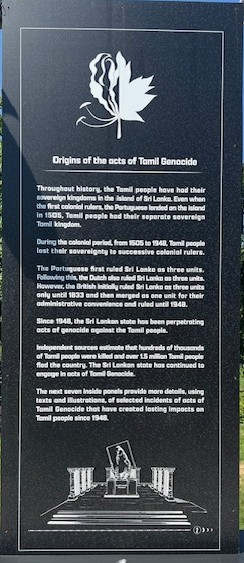
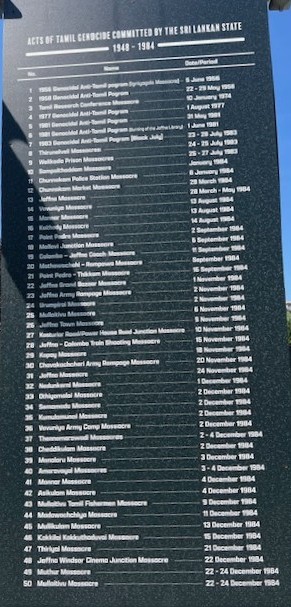
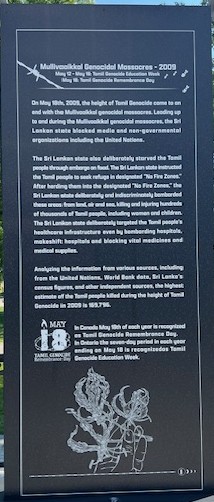
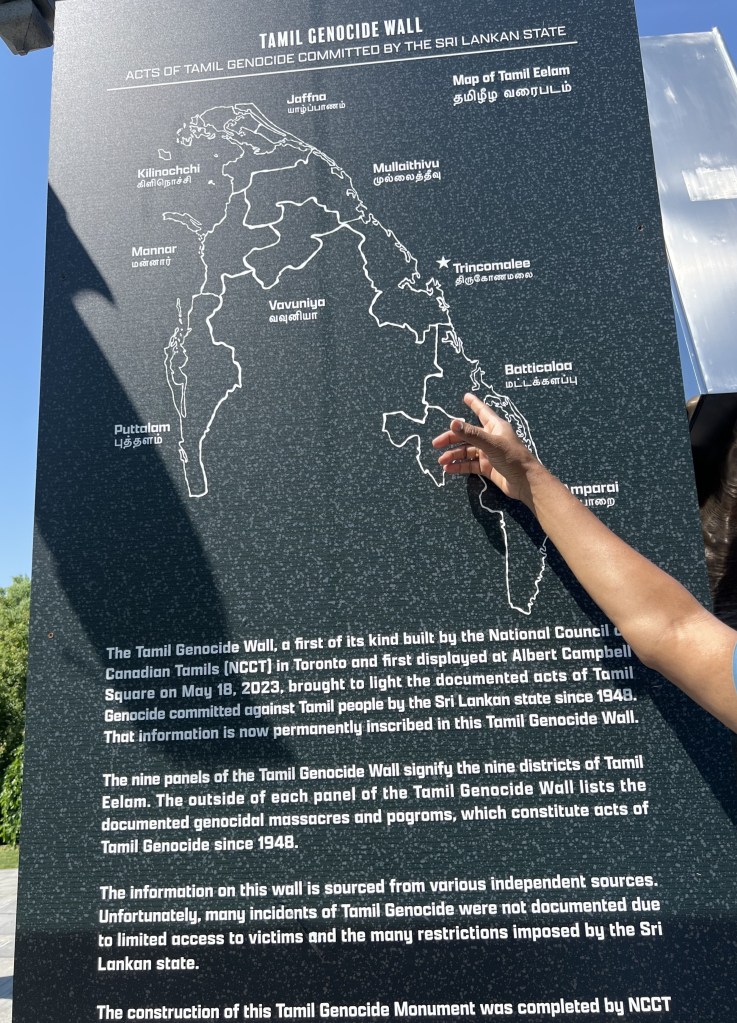
Creating counter-archives through literature is a powerful method of introducing alternate versions of history into the national consciousness. It is a form of resistance and remembrance, a way of honouring specters and healing through sharing. The Tamil Genocide Monument, recently built in Brampton, Canada, is a part of the Eelam Tamil-Canadian counter-archive. It not only honours the lives that were lost and displaced but also stands powerfully against genocide-deniers. Likewise, Vuong, Bui, Ganeshananthan, and Chandran provide versions of truths that were once relegated to the margins. Hence, literature like monuments, preserves histories of genocide and continue to challenge national archives.

 Global Anglophone Tamil Eelam Literature
Leave a reply to Simon Cancel reply