In a scholarly interview, V.V. Ganeshanthan discusses the pressure of representing a nation, particularly when asked to condense its complex history into a concise version. She shares that as an academic interested in the whole of Sri Lanka, she studies and talks about aspects that do not often get mentioned in mainstream discourses–such as the experiences of the Muslim community in Sri Lanka–in order to provide a more expansive version of history. Furthermore, she emphasizes that her expertise does not come solely from being related to Sri Lankans or having visited Sri Lanka, but rather from years of research and study (Jeyanthurai 307). I found this to be a crucial insight as I begin to embark on my own research journey. As an Eelam Tamilian myself, having grown up hearing stories upon stories of the war and genocide, it is easy to get trapped in a monolithic version of history. As such, I find Ganeshananthan’s approach–talking about what is rarely mentioned–– fascinating. Moreover, both in her novel Love Marriage and in the interview, Ganeshananthan emphasizes that, as a member of the Sri Lankan diaspora, she “wrote a (emphasis added) story, not the whole story” (Jeyathurai 307) and thus should not be viewed as a spokesperson for the nation’s history.
It is with this in mind that I turn to her poem “the faithful scholar dreams of being exact” published in the anthology Out of Sri Lankan: Tamil, Sinhala & English Poetry From Sri Lanka & its Diasporas. Ganeshananthan employs mathematical metaphors to illustrate the difficulty in writing about war, oppression, and genocide. The structure of the poem, with its lack of capitalizations, use of colons and em dashes, indicates a sense of restlessness, with no pauses or breaks. Despite the fact that there are periods in between some sentences, the block format, as well as the lowercase letters following the periods, suffocate the pauses in the poem, creating an image of a frantic mathematician attempting to solve a complex math problem. Through this imagery, Ganeshananthan speaks to the impossible task of presenting accurate stories amidst the loss, the dead, and the bruised. As a scholar, she cannot entirely put into words the damage done by the war and the genocide, no matter how many times she “corrects” the formulae.
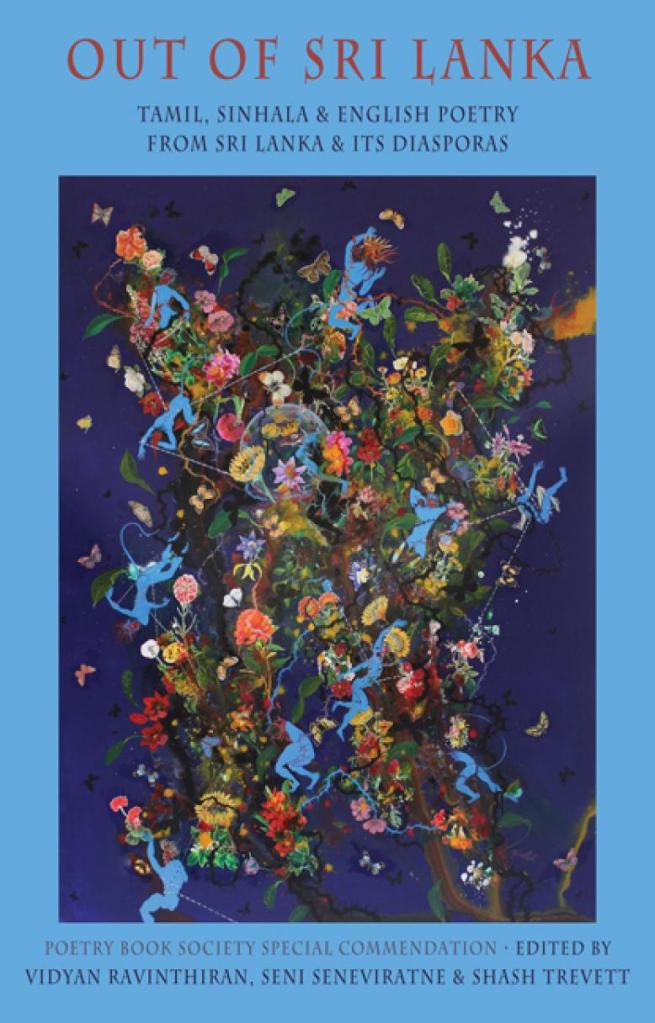
In light of bodies still being uncovered from mass graves in Sri Lanka today, Ganeshanthan’s poem speaks to the accuracy of death toll numbers and, consequently, the Sri Lankan government’s refusal to acknowledge its part in the genocide. The line “the impossible sum in which one must already believe to pursue proof” (lines 15-16) critiques the difficulty of proving that a genocide has occurred, thus pointing to the circular logic that the world must see enough bodies to believe that there is a genocide happening in order to obtain enough proof to punish the responsible party.
The faithful scholar finds herself in the precarious position of having to “speak for her people” and to speak on a war that has yet to leave our doorsteps. Writing stories of genocide comes with its own set of equations that beg to be solved in order to be proven. The burden of proof falls on the scholar who must present carefully curated evidence of genocide. Ganeshananthan’s poem beautifully illustrates the pressure of being a Western scholar and a pioneer in a contested field of study.
Works Cited:
Jeyathurai, Dashini. “Drawing Maps of Pain: An Interview with V.V. Ganeshananthan.” South Asian Review (South Asian Literary Association), vol. 33, no. 3, 2012, pp. 305–13, https://doi.org/10.1080/02759527.2012.11932909.

 Global Anglophone Tamil Eelam Literature
Leave a reply to Simon Cancel reply